Spring-System Diagnosis
The door's symptoms and hardware are checked to distinguish a failed spring from cable, drum, track, roller, or opener problems.
Serving Madison, Florida
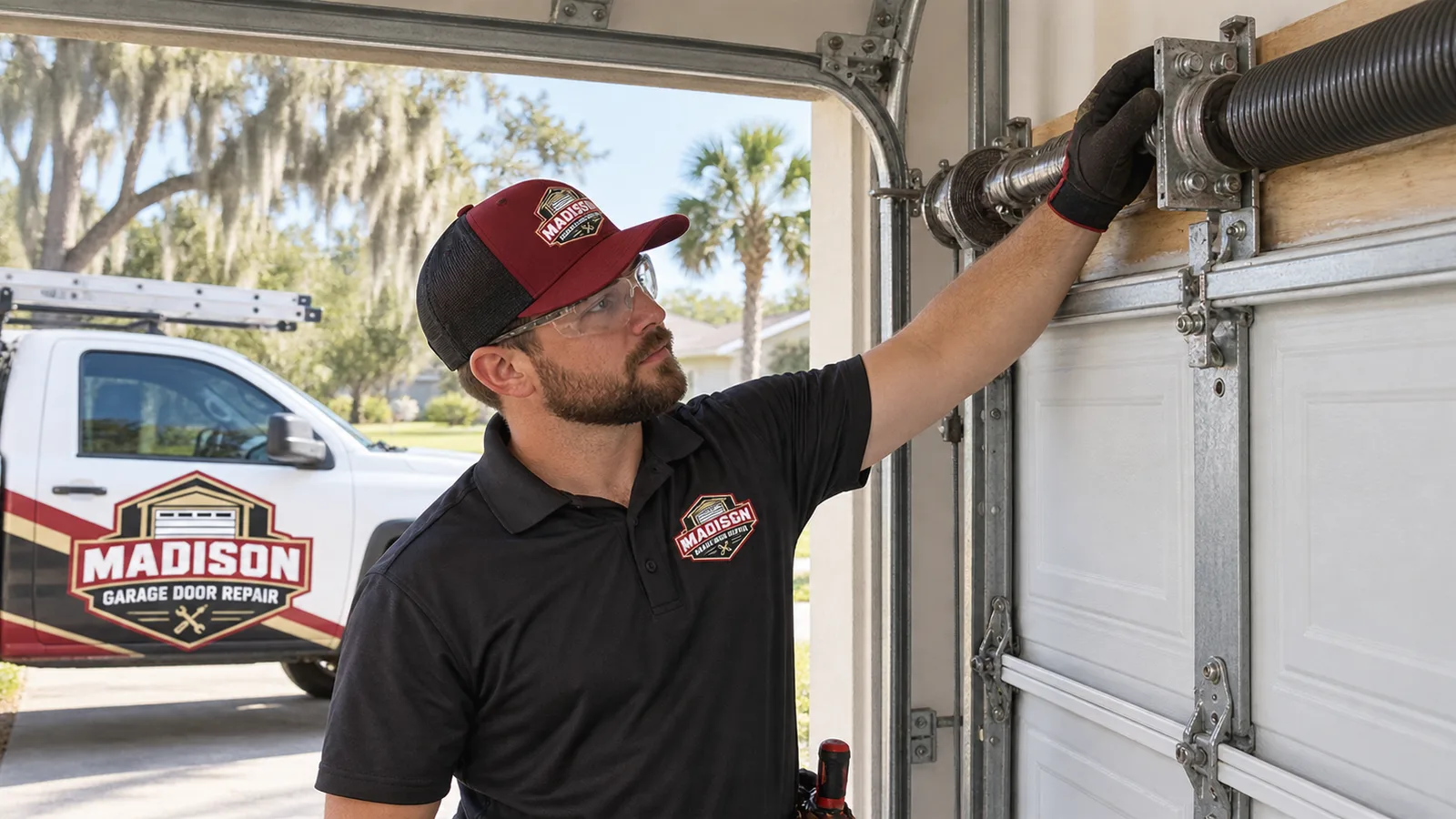
Garage door spring repair in Madison, Florida
Restore balanced door movement and dependable access with a careful diagnosis of broken, worn, or incorrectly tensioned springs.
Stop operating a spring-damaged door
A broken garage door spring can leave the door too heavy for the opener and unsafe to lift by hand. Madison Garage Door Repair provides garage door spring repair in Madison, FL for doors that will not open, stop after moving a short distance, hang unevenly, or make a sharp bang when a spring fails.
Springs counterbalance the weight of the door. When that lifting force is lost, repeatedly pressing the opener can strain the motor, rail, trolley, cables, and door panels. Disconnecting the opener does not make a spring-damaged door safe to lift. The full weight may move unexpectedly, and loose cables can leave the door crooked in its tracks.
Keep people, pets, and vehicles away from the door until it is inspected. For problems involving other operating parts rather than the spring system, garage door repair in Madison can address the wider door assembly.
Recognize a possible spring failure
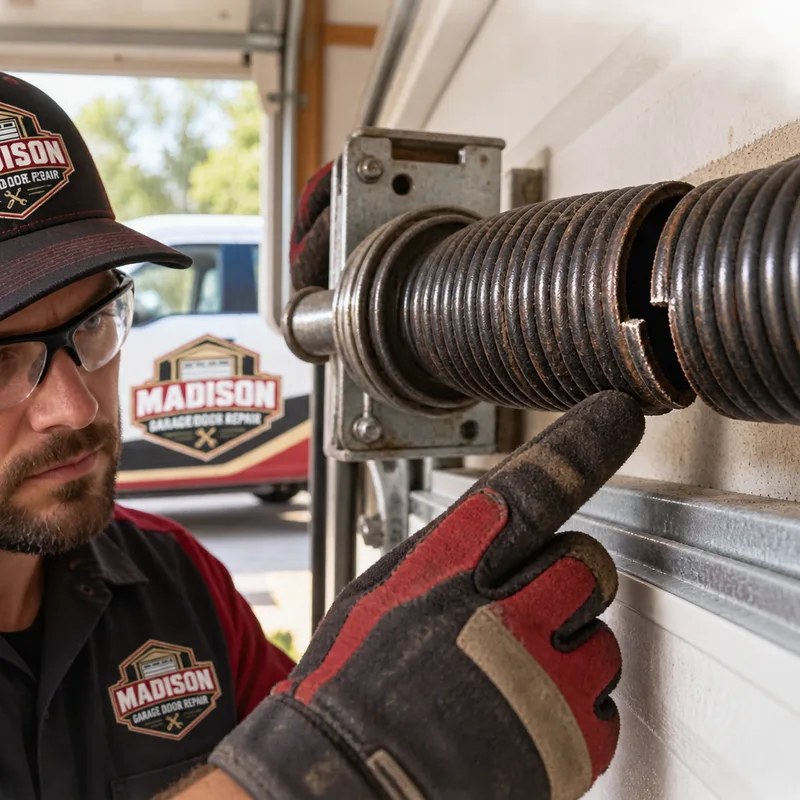
A visible gap in a torsion spring above the door is a strong sign that the spring has broken. Extension springs run along the horizontal tracks, so a stretched, separated, or hanging spring may be visible near one side. Other symptoms include a door that feels unusually heavy, rises only several inches, closes faster than normal, or sits lower on one side.
Jerking and uneven travel can also point to poor spring balance, but cables, drums, rollers, tracks, and hinges must be checked before the cause is confirmed. A working opener does not rule out spring trouble. Openers guide movement; they are not designed to carry the door's full dead weight.
Do not touch a spring, winding cone, bottom bracket, cable, or drum. These components can remain under substantial tension even when the door is closed. Avoid improvised clamps and attempts to wind a spring with screwdrivers or other makeshift tools.
Inspect the complete lifting system
The door's symptoms and hardware are checked to distinguish a failed spring from cable, drum, track, roller, or opener problems.
Replacement depends on door weight, height, track setup, spring dimensions, wire size, inside diameter, and winding direction. Appearance alone is not enough.
Lift cables must seat correctly in the drum grooves. Frayed cables, damaged drums, or a door that has shifted out of level can change the repair scope.
After spring work, the door should hold at intermediate positions and travel without excessive pull from the opener. Final checks confirm alignment and movement.
From symptoms to verified balance
The spring arrangement, cables, drums, brackets, tracks, and door condition are examined. Measurements and door weight determine the appropriate spring specifications.
The required spring work and any related damage are identified before repair begins. On paired systems, both springs should be evaluated because they have usually completed the same operating cycles.
The failed components are removed with proper controls, suitable springs are installed, and tension is set for the door rather than guessed by coil appearance.
Manual balance, cable tracking, drum seating, full travel, and opener operation are checked. The door should move smoothly without the opener compensating for poor spring balance.
Match the spring to the door
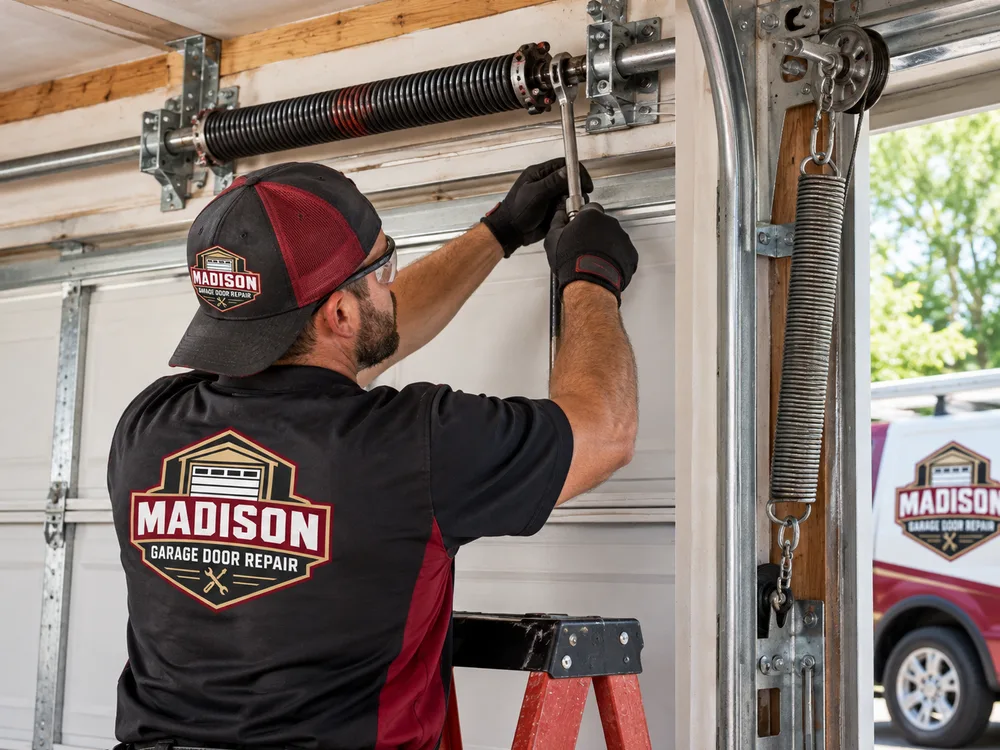
Torsion springs are usually mounted on a shaft above the closed door. They turn the shaft and cable drums to raise and lower the door. Extension springs are normally positioned beside the horizontal tracks and stretch as the door closes. The two systems use different hardware and repair procedures.
A replacement must match the door's lifting requirements. Wire diameter, coil diameter, spring length, winding direction, and door weight all affect a torsion spring selection. Extension systems require attention to spring strength, pulley condition, cables, and containment hardware. Installing a spring that merely fits can leave the door too heavy, cause it to rise on its own, or shorten the life of the opener.
Madison's warm, humid climate can contribute to corrosion on exposed metal components, particularly where moisture reaches uncoated springs, cables, or fasteners. Corrosion is not proof that a spring is about to break, but pitting, deformation, frayed cable strands, and unstable door balance warrant inspection.
Avoid added load and damage
Continuing to run a door with a broken or weak spring transfers extra load to components that were not intended to lift the full door weight. The opener may hum, reverse, or stop after a short movement. Cables can lose tension, jump their drum grooves, or become tangled. If one side drops, rollers may bind in the tracks and panels can twist.
Leave a stuck door in place unless movement is required to remove someone from immediate danger. Do not stand beneath it, pull the emergency release while the door is raised, or attempt to force the bottom edge upward. A raised door with failed spring support can fall quickly after the opener is disconnected.
Once repaired, simple observation helps identify future trouble. Listen for scraping or popping, watch whether both sides move together, and note whether the door stays near waist height when disconnected and moved manually. Lubrication should be limited to products and points suitable for the specific hardware; grease on tracks can collect dirt and interfere with roller travel.
If the door is too heavy to lift, sitting unevenly, or stopped with a visible spring gap, arrange an inspection before operating it again.
CALL NOW: (850) 290-0344Answers before spring service
Tell Madison Garage Door Repair what the door is doing, whether it is stuck, and if access is blocked. A proper inspection can identify the failed parts and establish the right repair scope.